

Be Kind Rewind
It’s 1993. The carpet is rough under my elbows. The CRT television's heavy warmth is radiating into the room.
I can still hear the specific, high-pitched whine of the VCR motor straining against the plastic gears. That sound didn’t just mean the movie was over; it was the audible death of Saturday night. It dragged me back from the neon streets of Jurassic Park to the beige reality of my living room.
Even after the film ended and the credits rolled, the ritual wasn’t done. I had to sit there for three dead minutes, watching the mechanical counter tick backward to zero while the tracking lines danced on the screen. The blue-and-white sticker on the cassette case frayed at the edges and smelled faintly of stale plastic, staring back with a simple command:
Be Kind Rewind.
We didn’t do it just because we feared the fifty-cent surcharge or the stern look from the staff. We did it because it was part of an unspoken social contract, a small act of civic maintenance that kept the system running for everyone else. You knew that if you returned a tape halfway through the third act, you were stealing time from the next person and passing on a burden that wasn’t theirs to carry. Rewinding was an act of invisible service for a stranger you would likely never meet, a way of saying that you valued their experience as much as your own.
My final memory of the video store era isn’t a warm, fuzzy montage of popcorn and laughter. It was a stand-off.
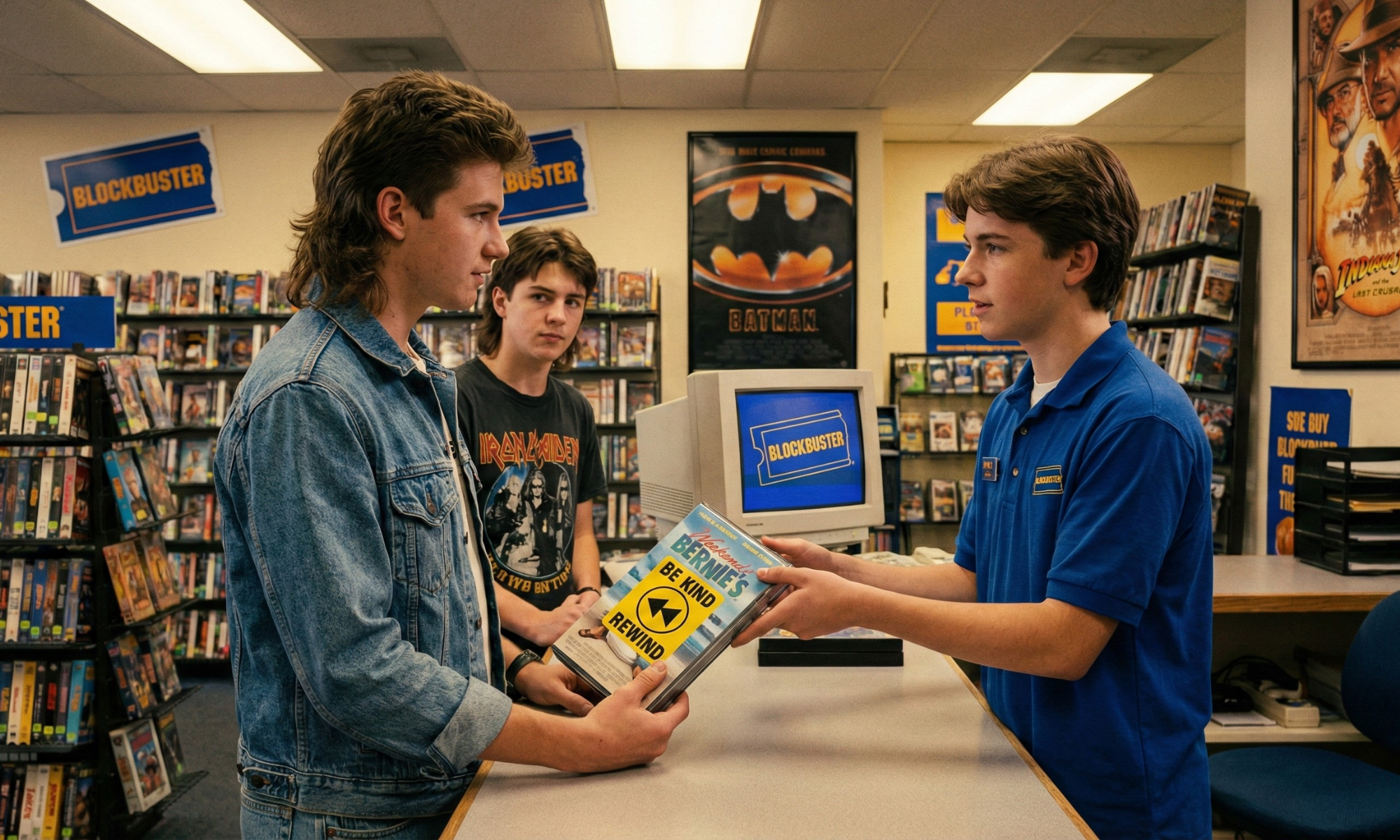
It was 2018. I was standing at the counter of our local store, wallet out, with Miffy, Kai, and Pippy lined up behind me like a phalanx of hopeful soldiers. They had their pick: Ready Player One (a great film, an ironic choice). We were ready for the ritual. But the gatekeeper, a girl no older than fifteen, stopped us cold.
“Sorry, mister,” she said, delivering the fatal blow. “But you are now banned. Too many late fines.”
We had left a few rentals at home during a trip away, and the late fees had metastasised into a precise and devastating sum: sixty-six dollars. It was my third warning. The ban was absolute. (Or maybe it was just a jagged Post-it note the manager left on the monitor that said DO NOT RENT TO THIS GUY).
In a digital world, that would be the end of the story. Game Over. Your account is locked, the screen goes black, and no one hears your side. But this was the analog world, and I was standing before a human being.
I didn’t walk out. I stayed. I looked around, genuinely awkward, feet glued to the linoleum. I really didn’t want to leave. The kids’ faces (aged 14, 11, and 8) just stared up at me in total horror.
“Banned?” Pippy whispered in a tone usually reserved for natural disasters. “From a video store? What on earth will we do now, Dad?”
I looked at the girl behind the counter. She looked at the kids. I thought, That’s it. This isn’t the end. It can’t be.
So we entered into a negotiation. I paid the sixty-six dollars, a painful penance. I offered a sincere apology. I explained the mistake, acknowledged the rules, and promised to have this film back on time, this time tomorrow, or else.
The ban was lifted. We walked out with our movie, clutching the plastic case like a trophy. My kids learned that day that sometimes an apology is a form of rewinding. It is a way to go back, fix the track, and prepare the ground for what comes next.
That friction is entirely gone now. We have traded the awkward human encounter for the seamless, lonely drift of the scroll. The digital world does not want you to rewind because it does not want you to pause. The algorithm is built on a philosophy of infinite forward motion, where the next video plays before you have processed the last one, and the feed refreshes before you can decide to leave. We traded the mechanical inconvenience of the rewind button for the seamless convenience of the slipstream, but we lost something vital in the exchange. We lost the moment of pause that allows empathy to breathe.
I have spent a lifetime hacking my own brain with this kind of voluntary friction because I realised early on that if I wanted to learn something real, I had to make it harder for myself, not easier. When I learned to touch type, I didn’t use a gamified app with rewards and badges. I put tape over the keys of my computer. I forced myself to stare at the screen, trusting my fingers to find the geography of the board without the visual crutch. I can still write on a Mac today without looking down because I spent weeks looking at nothing but masking tape. When I needed to fix my tennis serve, I didn’t just play more games where the score mattered. I hired a ball machine and hit three hundred serves to no one. Just the toss, the swing, and the thwack, over and over again.
Researchers have a name for this. They call it desirable difficulty. Robert Bjork at UCLA spent decades studying how people learn and found that when we remove all the friction from the learning process, we actually retain less. The struggle is not a bug in the system. It is the system. The tape on the keys, the three hundred serves to an empty court, the three minutes watching the VCR counter tick backward, these moments of productive friction are what encode the lesson into muscle memory and mental habit.
These are analog ways of teaching yourself that the result depends entirely on the preparation. You have to put the tape on the keys and hit the balls into an empty court. You have to rewind the tape so the movie is ready for the next viewing. It is about understanding that we have agency in how we learn and how we interact. We built the house we live in.
I saw this play out vividly when I was coaching a design program a few years ago. My cohort consisted of brilliant visual thinkers, people who could solve complex problems with shape and colour, but when it came to writing, they froze. They arrived with the same defensive shield: “I am not a writer.” They treated writing as a foreign country they had no passport for. But the program wasn’t about grammar; it was about thinking.
I watched these designers struggle with blank pages in a way they never did with a canvas. They’d write a sentence, dislike it, and delete it. They were afraid of looking foolish and of the awkwardness that comes before clarity. But over time, they saw that “bad” writing was the path to “good” thinking. They had to be willing to be wrong on the page before they could get it right. They learned that the “rewind” (the pause to think, organise, and care about the message) wasn’t wasted time. It was the real work.
We live in a moment when looking dumb is the ultimate sin, and we have built tools to ensure we never have to experience it. I am writing this right now with tools that check my spelling and smooth out my grammar. Sure, I use AI as a coach to bounce ideas off. These are incredible utilities. But there is a dangerous line we are flirting with. We are beginning to outsource both the thinking and the typing.
When we let an algorithm predict our next word, write our emails, or shape our whole worldview, we skip the hard parts. We skip the “garbage paragraph” I always write at the start of an article, the one I delete once I find my flow. That messy paragraph matters because it’s where I figure out what I really think. If a machine writes it for me, the result might look better, but I lose the chance to discover my own ideas.
Early research is backing this up. Studies from places like MIT and Stanford are showing what many of us already suspect: when we outsource word prediction and sentence completion, we are, sure, saving time. But we are offloading some of the cognitive work that makes thinking ours. The act of searching for the right word, of hitting a dead end and backtracking, of rewriting the same sentence five times until it sounds like you: that is not inefficiency. That is how we figure out what we actually mean.
We need to ask ourselves a hard question: Do you still know what you are about?
In a synthetic world, the most radical thing you can be is human, and being human means being occasionally clumsy. It means stumbling and having a thought that isn’t fully formed, and taking the time to wrestle with it. It means being willing to sound a little dumb in the first draft so you can sound like yourself in the final one. We need to be okay with making mistakes because mistakes are the friction that proves we are actually here.
We often talk about social media companies and AI models as if they are weather systems, forces of nature we just have to endure. We forget that they are businesses and we are the customers. We are the ones who decide how we engage. The algorithm might reward outrage and speed, but we possess the agency to choose kindness and slowness. We can choose to be the friction in the system.
“Rewinding” in 2026 means reading the post that made you angry and then waiting. It means letting the tape spin back to the start before you type. It means realising that the person on the other end is not a username to be defeated, but a neighbour in a digital community that is rapidly running out of good soil. It means checking in on a friend without an agenda, not with a “like” on their photo, but with a text that asks how they really are.
We don’t have the stickers on the cassette cases anymore, and we don’t have the fifteen-year-old at the counter to enforce the rules. We have to build the guardrails ourselves. The world is moving at infinite speed, and the bravest, most creative thing you can do is refuse to keep up. We have the power to enrich the soil of our communities, but only if we take the time to prepare the ground.
Be kind. Pause. Rewind.